Rights & Ownership of AI-Generated Music
Welcome, and thank you for visiting.
Whether you are a music fan, content creator, industry professional, talent scout, record label representative, licensing agent, or someone simply interested in AI-generated music, I believe transparency is important. This page exists to explain the ownership and rights associated with AI-generated music to the best of my knowledge, starting with the music published under my artist brand.
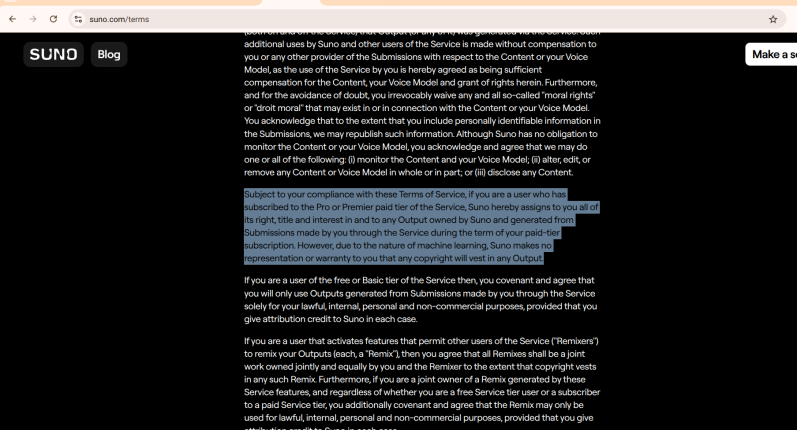
I create and release original music using artificial intelligence tools, including Suno. As a paid subscriber to the Suno Pro service, the music I generate through my account is covered by Suno's commercial ownership provisions. According to Suno's Terms of Service, paid Pro and Premier subscribers are assigned Suno's rights, title, and interest in the music generated through their paid subscription period, subject to compliance with those terms.
As a result, I maintain ownership and commercial usage rights for the music I create through my paid Suno subscription. This allows me to distribute, stream, promote, license, and monetize my music across supported platforms and services.
For anyone interested in licensing my music, collaborating on projects, creating content using my songs, or discussing business opportunities, please understand that I treat my music catalog as a professional creative work and reserve all applicable rights associated with it.
The purpose of this page is not only to explain my ownership position but also to provide information about the rapidly evolving world of AI-generated music. As laws, regulations, platform policies, and copyright interpretations continue to develop, creators and listeners alike benefit from understanding how these technologies fit within the modern music industry.
The information presented on this page is intended for educational and informational purposes only and should not be considered legal advice. Copyright and AI-related laws vary by country and may change over time. Anyone seeking legal guidance should consult a qualified attorney familiar with intellectual property and digital media law.
Thank you for taking the time to learn more about my music and the rights associated with it.
Last Updated: June 2026
Understanding Music Ownership: Traditional Music vs. AI-Generated Music
Who Owns a Song?
One of the most common questions in today's music industry is: "Who owns the rights to a song?"
The answer depends on how the music was created.
For decades, music ownership has been relatively straightforward. A songwriter writes lyrics and melodies, a producer creates the instrumental, performers record the track, and various copyrights are established based on who contributed to the work.
With the rise of artificial intelligence, however, new questions have emerged regarding ownership, licensing, and commercial rights. Understanding these differences is important for music fans, content creators, businesses, and industry professionals.
Ownership in Traditional Music
In traditional music creation, ownership is usually divided into two primary categories:
Composition Rights
These cover the songwriting itself, including:
- Lyrics
- Melody
- Chord progressions
- Musical arrangement
The songwriter or songwriters typically own these rights unless they transfer them to a publisher or record label.
Master Recording Rights
These cover the actual recorded version of the song.
The owner of the master recording is often:
- The independent artist
- A record label
- A production company
- A business that financed the recording
Because multiple people may contribute to a traditional song, ownership can be shared among several parties.
Ownership in AI-Generated Music
AI music introduces a different process.
Instead of recording instruments or writing every note manually, a creator uses an AI platform to generate music through prompts, instructions, editing, and creative direction.
The key factor is not simply whether AI was involved, but what rights the AI platform grants to the user.
Different AI music platforms have different licensing terms. Some platforms retain ownership, some provide limited commercial licenses, and others grant full ownership rights to paying subscribers.
Because of this, anyone creating AI music should always review the platform's Terms of Service before publishing, distributing, licensing, or selling music generated through that platform.
How to Obtain Rights to AI-Generated Music
Obtaining ownership of AI-generated music generally requires three steps:
1. Use a Platform That Grants Commercial Rights
Not all AI music platforms are the same.
Before generating music, verify that the platform explicitly grants users commercial usage rights and ownership permissions.
The platform's Terms of Service should clearly explain:
- Who owns the generated music
- Whether commercial use is allowed
- Whether tracks can be distributed
- Whether tracks can be sold or licensed
- Any restrictions that may apply
2. Maintain an Eligible Subscription
Many AI music services offer different levels of access.
In some cases:
- Free plans provide limited rights
- Paid plans provide commercial rights
- Professional plans provide broader ownership permissions
Always verify which rights are attached to your specific subscription level.
3. Follow the Platform's Terms
Ownership rights are generally conditioned on compliance with the platform's Terms of Service.
This means users should:
- Follow content guidelines
- Maintain eligible subscriptions when required
- Avoid prohibited uses outlined by the platform
Failure to comply with platform terms may affect licensing rights.
AI Does Not Automatically Mean Public Domain
A common misconception is that AI-generated music automatically belongs to everyone.
This is not true.
Ownership and usage rights are determined by the agreement between the platform and the user. Many AI platforms explicitly grant users commercial rights to the music they create.
As a result, AI-generated music may still be protected by contractual rights, licensing agreements, branding rights, and other legal protections.
My Music and Ownership Rights
All music featured on this website is generated using AI tools under licensing terms that grant me commercial usage rights and ownership permissions for my creations.
I maintain the necessary subscription status required by the platform and operate in accordance with its Terms of Service.
As a result, I retain the rights granted by the platform for the music I create and publish.
This means my music may be streamed, shared, licensed, promoted, or distributed according to the rights provided under the applicable platform agreement.
Final Thoughts
Artificial intelligence is changing how music is created, but ownership still matters.
Whether a song is produced in a recording studio or generated through advanced AI tools, understanding who owns the rights is essential for artists, content creators, businesses, and music industry professionals.
The most important rule is simple:
Always review the licensing terms of the platform used to create the music.
Ownership is determined not by the technology itself, but by the rights granted through the platform's agreement with the creator.
Frequently Asked Questions About AI Music Rights and Ownership
Can AI-Generated Music Be Owned?
In many cases, yes.
Ownership of AI-generated music depends primarily on the terms and licensing agreement of the platform used to create it. Different AI music platforms operate under different rules. Some grant users broad commercial rights, while others may retain certain rights themselves.
Before publishing, distributing, licensing, or monetizing AI-generated music, creators should carefully review the platform's Terms of Service and licensing policies.
Can AI Music Be Sold?
In many situations, AI-generated music can be sold, licensed, streamed, and monetized if the platform used to create the music grants those rights to the user.
Examples may include:
- Music streaming platforms
- YouTube content
- Podcasts
- Commercial advertising
- Video games
- Film projects
- Licensing agreements
However, the specific rights available depend on the platform's licensing terms and the user's subscription level.
Can Content Creators Use AI Music?
Content creators frequently use AI-generated music for:
- YouTube videos
- TikTok content
- Livestreams
- Podcasts
- Business presentations
- Marketing campaigns
Creators should always verify that they have the necessary rights and licenses before using any music in commercial projects.
Can Record Labels Sign AI Artists?
Yes.
Record labels, talent scouts, publishers, and music industry professionals are increasingly evaluating artists who use AI as part of their creative process.
What matters most is not whether AI was used, but whether the artist has a legitimate audience, strong branding, commercial potential, and clear rights to the music being distributed.
Many industry professionals focus on audience engagement and marketability rather than the specific tools used during production.
Does AI Music Automatically Belong to Everyone?
No.
A common misconception is that AI-generated music automatically enters the public domain. In reality, usage rights and ownership permissions are typically governed by the platform agreement between the creator and the AI service provider.
The fact that artificial intelligence was involved in creating a song does not automatically make that song free for anyone to use.
Why Rights Verification Matters
Whether you are a listener, content creator, business owner, licensing agent, or music industry professional, understanding music rights is essential.
Before using any AI-generated song, it is important to verify:
- Who created the music
- Which platform was used
- What rights were granted to the creator
- Whether commercial licensing is permitted
- Whether any restrictions apply
As artificial intelligence continues to evolve, transparency regarding ownership and licensing will remain an important part of the music industry.
Can AI Music Be Copyrighted in 2026? Understanding AI Music Rights and Ownership
Artificial intelligence has transformed the music industry, making it possible for artists, creators, and businesses to generate professional-quality songs in minutes. As AI music becomes more popular, one question continues to come up:
Can AI music be copyrighted?
The answer is more complicated than a simple yes or no. Copyright law, ownership rights, licensing agreements, and platform terms all play a role in determining who can use, distribute, sell, or profit from AI-generated music.
This guide explains how AI music rights work in 2026 and what creators should know before releasing AI-generated songs.
What Is AI-Generated Music?
AI-generated music is music created with the assistance of artificial intelligence software.
Instead of recording every instrument manually, creators provide prompts, lyrics, themes, genres, moods, or other instructions to an AI system, which then generates a complete song or musical composition.
Today, AI music is being used for:
- Independent music releases
- YouTube videos
- TikTok content
- Podcasts
- Commercial advertising
- Video game soundtracks
- Film and television projects
- Background music licensing
As AI tools continue to improve, more artists are building entire brands around AI-assisted music creation.
Can AI Music Be Copyrighted?
This is where things become complicated.
In many countries, copyright laws were written long before artificial intelligence existed. Because of this, legal systems are still determining how copyright protection applies to AI-generated content.
Generally speaking, copyright protection may depend on the level of human involvement in creating the final work.
Factors that may be considered include:
- Writing original lyrics
- Editing generated music
- Selecting prompts and creative direction
- Arranging songs
- Combining multiple AI-generated elements
- Producing and distributing the final release
Because copyright laws vary by country and continue to evolve, creators should stay informed about current regulations and seek professional legal advice when necessary.
Who Owns AI-Generated Music?
Ownership is often determined by the platform used to create the music.
Different AI music services have different licensing agreements and Terms of Service.
Some platforms:
- Grant users commercial rights
- Grant users ownership rights
- Allow music distribution and monetization
- Allow licensing and sales
- Retain certain rights themselves
This is why reading the platform's Terms of Service is one of the most important steps before publishing AI-generated music.
The rights associated with AI music are often governed by the agreement between the creator and the AI platform.
Can You Sell AI-Generated Music?
In many cases, yes.
If the platform grants commercial usage rights, creators may be able to:
- Upload music to streaming platforms
- Monetize YouTube videos
- License music to content creators
- Sell music directly to customers
- Use tracks in business projects
- Generate revenue from commercial use
However, creators should always verify the exact rights granted by the platform they use.
Not every AI music service provides the same level of ownership or commercial licensing.
Can Record Labels Sign AI Artists?
Absolutely.
Many record labels, publishers, managers, and A&R professionals are interested in artists who successfully build audiences, regardless of how their music is created.
In today's music industry, labels often focus on:
- Audience size
- Streaming performance
- Brand identity
- Fan engagement
- Revenue potential
- Consistency of releases
An artist who uses AI tools can still build a successful music career if they create compelling content and attract listeners.
Ultimately, most industry professionals care more about results than the specific tools used during production.
Why AI Music Ownership Matters
Ownership affects much more than simply posting songs online.
Rights ownership can impact:
- Commercial licensing opportunities
- Streaming revenue
- Publishing income
- Distribution rights
- Business partnerships
- Advertising usage
- Brand collaborations
Understanding who owns the rights to a song helps prevent future disputes and ensures that creators know exactly what they are allowed to do with their music.
My Approach to AI Music Creation
The music featured on this website is created using AI-assisted tools under licensing terms that provide commercial usage rights for the music I generate.
I believe transparency is important. Visitors, listeners, content creators, and industry professionals deserve to know how music is created and what rights apply to that content.
As AI technology continues to evolve, I remain committed to following platform licensing agreements and respecting applicable intellectual property laws.
The Future of AI Music Rights
Artificial intelligence is changing the way music is created, distributed, and consumed.
While laws and regulations continue to evolve, one thing remains clear: understanding ownership and licensing rights is essential for every creator.
Whether you're an artist, content creator, business owner, music fan, or industry professional, always take the time to understand the rights attached to AI-generated music before using it commercially.
The future of music may be powered by artificial intelligence, but ownership and licensing will continue to play a critical role in protecting creators and supporting innovation.
---
Disclaimer: This article is provided for informational and educational purposes only and should not be considered legal advice. Copyright laws, ownership rights, and licensing regulations vary by jurisdiction and may change over time. Consult a qualified attorney for legal guidance regarding specific situations.