

The Complete Cannabis Guide 2nd chapter
sd⚠️ Disclaimer: This guide is for educational and entertainment purposes only and is not medical or legal advice. Cannabis can carry risks and may interact with medications. Always consult a qualified healthcare professional for medical questions and check the laws in your area before using cannabis. Full Disclaimer at the bottom
Chapter 2: Cannabis Anatomy – Nature's Tiny Chemical Factory
"Every sticky bud tells a story. Behind the aroma, the crystals, and the cannabinoids is a remarkably sophisticated plant built by millions of years of evolution."
Introduction
When most people picture cannabis, they imagine a green plant covered in sticky buds. But few stop to wonder why the plant grows that way.
Why are the flowers covered in crystals?
Why do they smell like pine, lemons, berries, diesel fuel, or fresh oranges?
Why do only certain plants produce the buds people consume?
The answers lie in the biology of cannabis.
Understanding how each part of the plant works is the first step toward understanding everything else we'll discuss in this guide—from cannabinoids and terpenes to cultivation and harvest.
By the end of this chapter, you'll never look at a cannabis plant the same way again.
The Life Cycle of Cannabis
Like all flowering plants, cannabis follows a predictable life cycle.
Each stage has a specific purpose.
1. Seed
Everything begins inside a tiny seed.
Although it may look lifeless, each seed contains an embryo along with enough stored energy to support the young plant during its first days of life.
When moisture, oxygen, and warmth are present, germination begins.
A tiny root called the radicle emerges first, anchoring the seedling into the soil.
2. Seedling Stage
Within a few days, the stem pushes upward while the first pair of small, rounded leaves—called cotyledons—unfold.
These aren't true cannabis leaves.
They're temporary energy factories that help the plant survive until its first serrated leaves develop.
During this stage, the plant is delicate and vulnerable to overwatering, pests, and extreme temperatures.
3. Vegetative Growth
This is when cannabis grows rapidly.
Roots spread deeper.
Branches multiply.
Leaves become larger and more numerous.
The plant focuses almost entirely on building its structure.
Think of this as constructing the framework of a house before adding the furniture.
The stronger the framework, the greater the plant's potential to produce healthy flowers later.
4. Pre-Flower
Eventually, the plant begins showing its sex.
Tiny structures called pre-flowers appear where branches meet the main stem.
This is the first opportunity for growers to identify whether a plant is male or female.
5. Flowering
Now the transformation begins.
Female plants redirect their energy into producing dense clusters of flowers rich in aromatic resin.
These flowers are what most people simply call "buds."
6. Harvest
When the flowers have matured and the resin glands reach peak development, growers harvest the plant.
But contrary to popular belief...
Harvest isn't the finish line.
It's just the beginning of the final stage.
7. Drying and Curing
Fresh cannabis contains far too much moisture to smoke properly.
Drying slowly removes excess water.
Curing allows the remaining moisture to redistribute evenly while chlorophyll breaks down.
This process improves smoothness, aroma, and flavor.
Many connoisseurs consider curing just as important as growing.
Meet the Cannabis Plant
Every part of cannabis serves a purpose.
Let's explore each one.
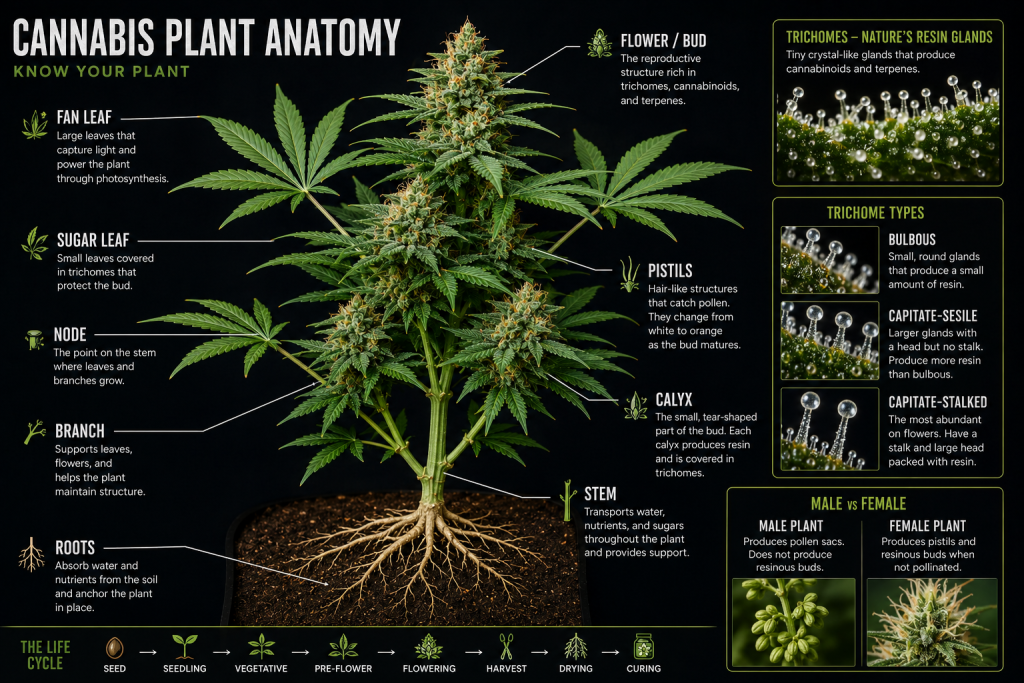
Roots
The Underground Network
Hidden beneath the soil is an incredibly complex root system.
Roots do much more than absorb water.
They also collect nutrients such as nitrogen, phosphorus, potassium, calcium, and magnesium.
Healthy roots anchor the plant while forming beneficial relationships with microorganisms in the soil.
Some fungi even extend the plant's reach by helping transport water and minerals in exchange for sugars produced through photosynthesis.
Without healthy roots, healthy buds simply aren't possible.
The Stem
Nature's Highway
The stem acts like a transportation system.
Water travels upward from the roots.
Sugars produced in the leaves travel throughout the plant.
The stem also provides structural support, allowing the plant to hold heavy flowers toward the sun.
A strong stem is often a sign of vigorous growth.
Fan Leaves
Solar Panels Built by Nature
Those large, recognizable cannabis leaves are called fan leaves.
Their primary job is photosynthesis.
Using sunlight, carbon dioxide, and water, they create sugars that fuel the entire plant.
Although fan leaves contain only small amounts of cannabinoids compared with flowers, they are absolutely essential for healthy growth.
If you've ever seen leaves turn yellow or develop unusual spots, the plant may be signaling nutrient deficiencies, disease, or environmental stress.
Growers often "read" the leaves much like doctors read symptoms in a patient.
Sugar Leaves
Near the flowers you'll notice much smaller leaves.
These are called sugar leaves because they become coated with sparkling trichomes.
Although usually trimmed before sale, they're highly valued for making concentrates and extracts because they contain significant amounts of resin.
Nodes and Internodes
Where every branch meets the main stem is called a node.
The space between two nodes is called an internode.
Growers pay close attention to internode spacing because it influences plant shape, airflow, and light penetration.
Short spacing often leads to bushier plants.
Long spacing creates taller plants.
Branches
Branches support future flowers.
Many cultivators gently bend or train branches to create a more even canopy, helping more flowers receive adequate light.
Rather than allowing one tall central stem to dominate, training techniques can encourage the plant to produce multiple large flowering sites.
Pistils
The White Hairs
One of the easiest ways to recognize a female plant is by its pistils.
These thin white hairs emerge from tiny flower structures.
Their biological purpose is simple.
They're designed to catch airborne pollen from male plants.
If pollination never occurs, the female continues producing larger, resin-rich flowers.
If pollination does occur, much of the plant's energy shifts toward producing seeds instead.
This is why growers cultivating seedless flower remove male plants before they release pollen.
Calyxes
The calyx is one of the smallest yet most important structures on the cannabis flower.
Each calyx houses the plant's reproductive organs.
As flowering progresses, calyxes swell and stack together, forming the dense buds familiar to consumers.
A mature flower is actually composed of hundreds of individual calyxes packed tightly together.
Male vs. Female Plants
Cannabis is unusual because individual plants are typically either male or female.
Male Plants
Male plants develop clusters of pollen sacs instead of resinous flowers.
Their role is reproduction.
Once mature, they release pollen into the air.
Female Plants
Female plants produce the aromatic flowers prized by growers and consumers.
These flowers become increasingly resinous as they mature.
If no pollen reaches them, they continue investing energy into flower and resin production.
This is why seedless cannabis, often called sinsemilla (Spanish for "without seeds"), became the standard for high-quality flower.
Trichomes
Nature's Tiny Chemical Factories
If cannabis had a treasure chest...
This would be it.
Look closely at a mature bud under magnification.
You'll see thousands of tiny mushroom-shaped structures covered in sticky resin.
These are trichomes.
Inside these microscopic glands, cannabis manufactures many of its most important compounds, including cannabinoids, terpenes, flavonoids, and aromatic oils.
Without trichomes, cannabis wouldn't smell the same, taste the same, or produce the same effects.
Why Does Cannabis Produce Resin?
Here's something many people don't realize.
Cannabis didn't evolve to produce THC for humans.
The plant has no idea people exist.
Scientists believe resin serves several protective functions, including:
- Shielding delicate flowers from ultraviolet (UV) radiation
- Discouraging insects and herbivores
- Helping protect against certain pathogens
- Reducing water loss in hot, dry environments
The same sticky resin that protects the plant also happens to contain the compounds humans value most.
Three Types of Trichomes
Not all trichomes are the same.
Cannabis produces three primary types.
Bulbous Trichomes
The smallest and least noticeable.
They contain relatively small amounts of resin.
Capitate Sessile Trichomes
Larger than bulbous trichomes, these contribute more to the plant's chemistry.
Capitate-Stalked Trichomes
These are the stars of the show.
Visible with a jeweler's loupe or microscope, capitate-stalked trichomes produce most of the cannabinoids and terpenes found in mature flowers.
When people describe frosty, crystal-covered buds, these are the structures they're seeing.
When Is a Plant Ready to Harvest?
Experienced growers rarely rely on the calendar alone.
Instead, they examine trichomes under magnification.
Trichomes change appearance as they mature:
- Clear: Cannabinoids are still developing.
- Cloudy or milky: Often associated with peak cannabinoid production.
- Amber: Indicates further maturation and chemical changes over time.
Many growers harvest when most trichomes are cloudy with a smaller percentage turning amber, though the ideal timing depends on the desired result and cultivar.
Drying vs. Curing
These terms are often confused, but they describe different processes.
Drying removes moisture to help prevent mold and prepare the flower for storage.
Curing is a slower aging process that allows moisture to equalize within the flower while preserving aroma and improving the overall smoking experience.
A properly cured flower is often smoother, more flavorful, and better at retaining its terpene profile than one rushed to market.
Did You Know?
🌿 A single mature cannabis flower may contain hundreds of thousands of trichomes.
🌿 Hemp and hops are close botanical relatives in the Cannabaceae family.
🌿 Trichomes appear on many plants—not just cannabis. Tomatoes, mint, and lavender also produce them, though with different functions and compounds.
🌿 Cannabis flowers are among the most chemically diverse plant structures studied by scientists.
Key Takeaways
By now, you've learned that a cannabis plant is far more than a collection of leaves and buds. Every root, leaf, branch, flower, and trichome plays a specialized role in helping the plant survive, reproduce, and protect itself.
The sticky resin so many people associate with cannabis is actually part of an elegant natural defense system—one that just happens to produce compounds that interact with the human body in remarkable ways.
Understanding the anatomy of the plant gives you a foundation for everything that follows. In the next chapter, we'll begin separating one of cannabis culture's biggest myths from modern science.
Next Chapter
Chapter 3: Indica vs. Sativa vs. Hybrid – Is It Really That Simple?
We'll explore where these labels came from, what they mean today, why two "indicas" can feel completely different, and why many experts now pay more attention to a plant's cannabinoid and terpene profile than its traditional classification.
fCannabis Guide Disclaimer
Disclaimer — Educational & Entertainment Purposes Only
The information provided in this cannabis guide is intended for general educational and entertainment purposes only. It is not medical advice, legal advice, or a substitute for professional medical care, diagnosis, or treatment.
Cannabis can affect people differently, and its effects, risks, interactions, and legal status can vary depending on the individual, product, dosage, method of use, and location. Nothing in this guide should be interpreted as a recommendation to use cannabis or cannabis-derived products to diagnose, treat, cure, or prevent any disease or medical condition.
We are sharing information, research, history, personal perspectives, and general knowledge about cannabis—not prescribing or recommending medical treatment. Always consult a qualified healthcare professional before using cannabis or cannabis-derived products for a medical purpose, especially if you take medications, have an existing medical condition, are pregnant or breastfeeding, or have other health concerns.
Laws regarding cannabis vary by jurisdiction and can change over time. Readers are responsible for understanding and following the laws that apply to them.
Sideon-Vibe does not guarantee that every piece of information in this guide is complete, current, or applicable to every individual. When making decisions about your health or safety, rely on qualified professionals and current, reputable sources.
By reading this guide, you acknowledge that you are using the information at your own discretion and that the material is provided for educational and entertainment purposes only.